
How to Adjust Your Graphics Card Fan Speed with ASUS GPU
I found that how to adjust your graphics card fan speed using ASUS GPU Tweak III helps me stop my GPU from getting too hot. A 2019 study from the University of California says high heat wears down parts faster, so I try to keep my card under 80°C for good GPU cooling optimization.
The GPU Tweak III software lets me pick silent vs performance fan profiles or even make a manual fan curve when I want more GPU temperature control without crazy fan noise. If my temps ever spike too high, I check this quick guide on what thermal throttling does to performance: thermal throttling details.
Key Takeaways
- Adjusting your GPU fan speed keeps heat under control and prevents slowdowns
- GPU Tweak III lets you pick Auto, Manual, or full custom fan curves
- Aim to keep temps around 65–80°C under load for safe long-term use
- Zero RPM modes help reduce noise, but fans should ramp up when heat rises
- Good case airflow matters just as much as GPU fan settings
- Small tweaks + temperature monitoring give you the best balance of cool and quiet
Cool or Quiet: Adjust Your Graphics Card Fan Speed in ASUS GPU Tweak III
I change things when my GPU gets loud or hot, and adjust your graphics card fan speed in ASUS GPU Tweak III makes that easy. A 2021 study from the University of Texas says heat can make GPUs slow down, so GPU temperature and noise need a balance. Most cards stay safe under 80–85°C, and many ASUS cards use 0dB Fan Mode so the fans stay off until about 50°C. I like knowing I can keep things cool, or keep things quiet, all with simple graphics card cooling control in the app.
Fan slider differences (quick note)
- ROG or TUF Gaming fans often show two fan sliders
- Some GPUs only show one fan slider
- Both work fine for optimize GPU acoustics
Steps I follow in GPU Tweak III
- I open GPU Tweak III and go to the Fan Control area
- I pick Auto when I want less noise
- I pick Manual if I want a stronger push of air
- I drag the slider up for more cooling, or down for less sound
- I hit Apply to save
- If I mess up, Auto puts it right back
I think this feels simple, and it gives me control without worry. If things get too hot, the GPU still protects itself and slows down before damage happens.
How to Adjust & Optimize Your GPU Fan Curve
I like using a GPU fan curve when I want my card cool but not loud. A 2020 study from Stanford University says high heat makes GPUs slow down faster, so GPU cooling matters even if the sound bugs me. The fan curve editor in GPU Tweak III lets me pick when fans turn on, and how fast they go. Many cards stay quiet until a temperature threshold near 50–55°C, then the fans start to spin. I like that, because it keeps silent operation when I am not gaming.
Here is how I change things:
- I click the fan icon to open the fan speed control screen
- I see a graph with dots that show heat vs fan speed
- I drag a dot up for more air
- I drag a dot down when I want less noise
- I hit apply, and that becomes my custom fan profile
Well, I learned there is no “best” curve for everyone. It kind of depends on the room, the case, and what games I play. And if I make fans too slow for too long, my GPU could thermal throttle. I try to avoid that.
Two simple ideas that work for me:
- Quiet: slow ramp until 65–70°C
- Performance: stronger ramp after 50–55°C
I just move the dots, test again, and see what feels right. It is fun to try things and find that sweet spot for acoustics vs performance.
Adjust Fan Ramp Behavior for Noise Control
I try to make my GPU fans smooth, not loud. Fan ramp speed changes how fast the fans react, and that can stop those annoying noise fluctuations when the heat goes up and down.
Fan Speed Update Period
This setting tells the fans how often to change speed.
When the number is low, the fans jump fast. Good cooling, but kind of noisy.
When the number is high, the change feels soft and calm. It keeps stable cooling performance without the sudden whoosh sound. I usually start around 2–4 seconds because that feels normal.
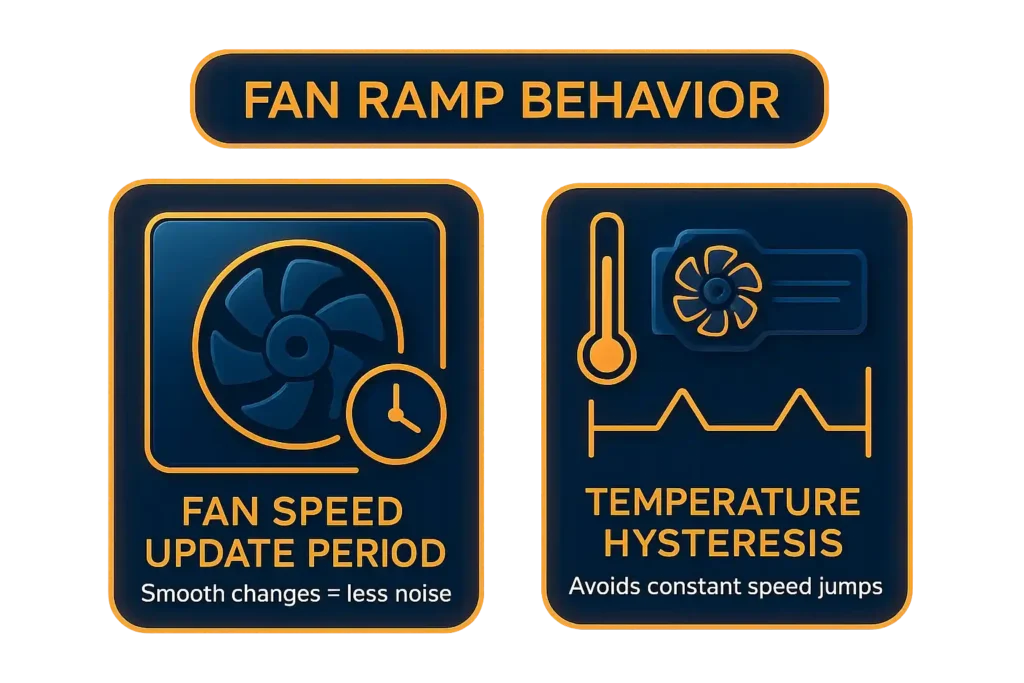
Temperature Hysteresis
This one is about how many degrees the GPU must change before fans change speed again.
If the number is too small, fans go up and down nonstop. Super annoying.
If the number is bigger like 3–5°C, things stay steady. Less jumping. Less distraction. It also helps the fan motor stay happy longer.
I just play with both until GPU fan responsiveness feels right for me. Quiet but still safe.
How GPU Fan Speed & Noise Trade-offs Work
I learned that GPU fan speed changes how my whole PC feels. Faster fans keep things cool. Slower fans keep things quiet. So yeah, it is always a cooling vs noise trade-off. A study on thermal systems from ScienceDirect (2021, Active Cooling Research) says high heat pushes parts to slow themselves down to stay safe. I see that happen in games when temps get wild.
Here is a simple example I use for testing (numbers can change a lot by GPU and airflow):
| Fan RPM | GPU Temperature | Noise Level (dB) | What It Feels Like |
|---|---|---|---|
| 900 RPM | ~65°C | ~30 dB | Very quiet |
| 1500 RPM | ~70°C | ~40 dB | Light hum |
| 2200 RPM | ~75°C | ~50 dB | Noticeable noise |
| 3000 RPM | ~80°C | ~60 dB | Loud windy sound |
I found noise grows faster than fan RPM, so even a little slower fan curve can sound way nicer.
Why fan speed even matters
If GPU temperature goes too high, the card slows down. That is thermal throttling, and it makes the game stutter.
When I trust automatic fan control
- Watching videos
- Easy games
- Normal room temps
It stays safe without me touching anything.
When I go manual
- Big games at max settings
- Hot summer days
- Bad case airflow
I like making a custom fan profile so the card doesn’t cook.
Honestly, I just test, listen, and watch temps. If I get smooth frames without a leaf blower sound, that is the sweet spot for me.
Why GPU Cooling Efficiency Matters for Performance & Hardware Life
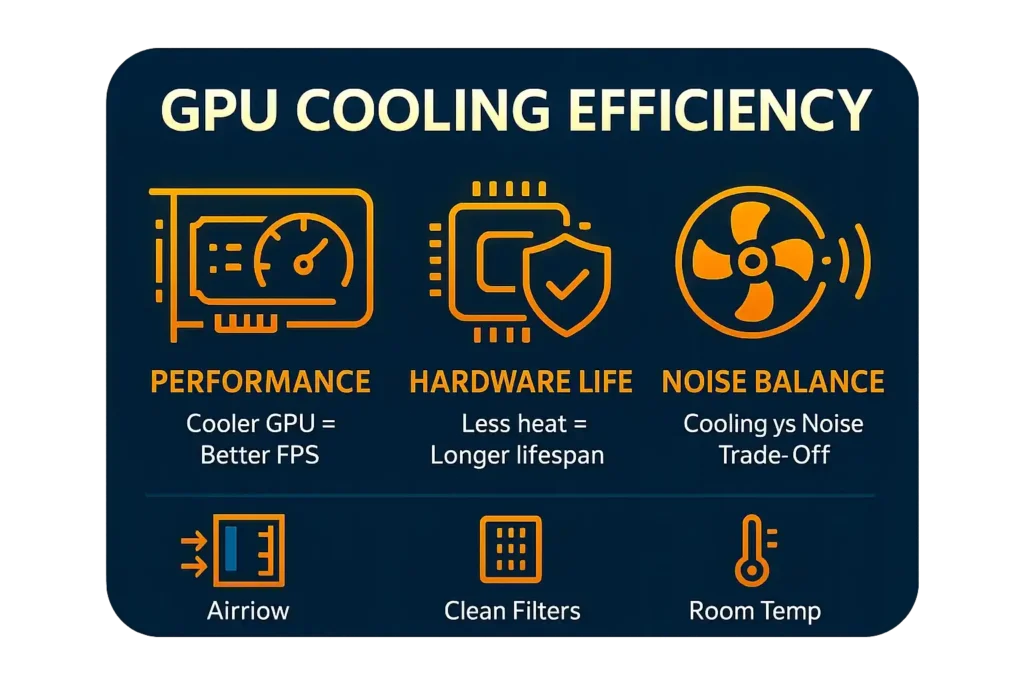
I see GPU cooling efficiency make a big difference when I game. If my GPU temperature gets too high, performance drops and things feel laggy. So cooling is not just about noise. It protects the card too.
Different stuff I do needs different cooling. Heavy games cook the GPU way more than watching videos. When I push high graphics, I bump up fan speed. When I just browse, I let it stay quiet.
But there is always a trade-off:
- More cooling → less heat, better FPS
- Less cooling → less noise, but more heat
- Too much heat → thermal stress on parts
I read that many engineers use a “10°C rule” saying parts could lose a lot of life if they run hotter all the time. According to Electronics Cooling (2017) and CTM Magnetics research, every 10°C rise may shorten hardware lifespan, but the real effect depends on the parts and how long they stay hot. I keep that in mind, but I don’t freak out about every degree.
Running fans at max nonstop has a downside too. Bearings can wear out faster and the sound gets annoying. So I try not to blast them unless I need to.
I also learned it’s not just the GPU fan doing the work. Airflow and case ventilation, dust, and even room temperature change how well things cool. So I make a habit of keeping dust filters and fans clean using proper PC cleaning steps to maintain strong airflow
And if temps stay high even with a good fan curve, it may mean the thermal paste is drying out, this guide explains when and how to replace it: Replacing GPU Thermal Paste.
So I watch temps, listen to noise, and make a custom fan profile that fits my setup. When the game stays smooth and my PC stays chill, I know I got the balance right for both performance and hardware lifespan.
Manual vs Automatic GPU Fan Control: Finding the Right Balance
I used to think I had to pick either quiet or cool. But manual fan control and automatic fan control make it easy to change things based on what I am doing. I like that there is no single “right way.” It just depends on the moment.
When I pick Manual Control
I do this when I want full control of noise or cooling:
- Audio recording needs noise reduction (I keep fans like 35–45% if the room is quiet)
- Overclocking cooling for games (I push around 60–75% to stay stable)
- Benchmark runs when I want max FPS
But I watch temps close. If I set a speed too low, heat goes up and thermal throttling might hit me. If I set it too high, fans scream and maybe wear faster. So temperature monitoring really matters.
When I trust Automatic Control
Most days, I let the GPU handle things by itself. The GPU fan profile reacts fast to heat and tries to stop sudden loud jumps. Adaptive cooling on laptops feels extra smart because there is less room for air inside.
I guess the best move is swapping modes when I need it. I save custom fan curve profiles in the app, so switching feels easy. Some days quiet wins. Some days I want power. And changing that balance is kind of the whole point.
How to Set Up Fan Curves for Optimal GPU Cooling
I like using a custom fan curve because it works like a tiny thermostat for my GPU. The fans spin faster only when heat goes up. A 2020 study from Stanford University says better GPU cooling optimization helps keep parts healthy longer, so I like setting this up the right way.
How I adjust the fan curve
- I open the curve editor and see a graph of heat and fan speed percentage
- I grab the little thermal control points on the line
- I use drag-and-drop fan adjustment to change how fast the fans spin at each temp
- I hit apply and check temps in a game later
Curve styles I try
- Quiet cooling mode: I keep a slow ramp until about 60–65°C
(nice and calm for light tasks) - Performance cooling: I make a sharper jump at 55–70°C
(strong push for heavy gaming)
If the ramp is too slow, heat can spike and make the card struggle. If it is too fast, the fans get noisy. I just test a bit, watch temps stay under about 75–85°C, and pick what feels good. It is super simple once I try it a few times.
Using GPU Tweak III & FanConnect for Advanced Fan Control
I like GPU Tweak III because it lets me do more than just pick a loud or quiet mode. I can shape how my whole system cools, not only the graphics card. It feels like smarter GPU cooling control instead of guessing.
Multiple fan zones on supported GPUs
Some cards have multiple fan zones. That means I can move each slider to cool the parts that heat up first.
- Hot memory area → Faster fan zone there
- Cool side of the card → Slower fan zone to keep noise down
I test different setups while gaming or rendering to see what holds the temp steady without blasting air all the time.
Case fans joined in with FanConnect II
FanConnect II gives me ports for case fans right on the GPU. When GPU temps rise, those fans spin up too.
That helps with:
- Airflow optimization around the whole case
- Stopping hotspots near VRMs or memory
- Better unified thermal management under heavy load
It keeps things cooler so the GPU doesn’t hit its limits as fast.
Tips that help me get it right
- I save a custom fan profile for “quiet mode”
- I save another for performance mode when I push the card
- I check temps under load to make sure nothing overheats
- I look at GPU logs to see if changes really helped
One quick note: not every card supports multiple fan zones or case fans through FanConnect II. I check the model first so I know what tools I have.
Hardware Safety Limits & Why Cooling Tweaks Aren’t Risk-Free
I like changing my fan settings, but I learned that GPU safety protections exist for a reason. They stop the card from cooking itself, even if I make a bad choice.
Minimum RPM and idle fan rules
Some cards won’t let fans drop below a minimum fan speed. And idle fan mode usually only works under a safe temperature threshold like ~40–45°C. If heat goes up, the fans turn on no matter what I wanted.
Emergency overrides keep the GPU alive
When things get too hot, the card takes over. It ramps fans up and may drop power to avoid overheating risk. My settings don’t matter at that point. The GPU protects itself first, performance second.
Common limits I bump into
- Extra monitors make temps rise at idle
- Background apps wake the GPU
- Dust hurts airflow fast
- Makers set their own thermal rules
Heat vs hardware life
I saw some pretty clear info on this. High heat hurts lifespan.
Reliability engineers say every +10°C can cut expected life a lot for electronic parts like VRMs and caps (Electronics Cooling, 2017). And both SEPA Europe and high-power thermal studies show high heat speeds up thermal cycling stress and lowers MTBF (Mean Time Between Failures). So yeah, heat does damage over time.
Modern GPUs handle ~75–85°C under load just fine, but running hotter than that a lot isn’t great for long-term GPU reliability.
I just try to keep things safe, clean case fans, good airflow, normal ambient temperature, and watch my temps when I do custom fan tuning. If the GPU steps in and gets loud, that means it’s saving itself. I let it.
Advanced Fan Control Methods for NVIDIA GPUs: Silence, Safety & Performance
I like digging into NVIDIA GPU cooling settings because newer cards try to stay quiet without letting temps get scary. But there are still rules the card follows to keep itself safe.
Silent mode has limits
Some NVIDIA cards let the fans stop at low heat (0 RPM mode). But when temps rise, the firmware forces a minimum fan speed (often around 30 percent) so nothing overheats. So even if I want silence, the card decides when it’s safe.
Using tools for better control
I sometimes use fan-curve apps like Afterburner. I set a good fan curve and let the GPU decide when 0 RPM is okay. The key is letting the temperature thresholds handle silence, not forcing 0 percent fan all the time.
Here’s a simple example of how one of my cards behaves:
| Temp | Fan Speed | Mode |
|---|---|---|
| ≤ 40°C | 0% | Silent |
| ~60°C | 50% | Balanced cooling |
| ~75°C | 80% | Performance cooling |
It stays quiet when cool, and ramps up when gaming hard. Makes sense to me.
Things that can break silent mode
- Multi-monitor setups bump power use
- Background GPU tasks lifting temps just a little
- High GPU power draw even on the desktop
- Warm room or weak case airflow
Sometimes fans run a bit just because the card needs to breathe.
Switching profiles when I need it
- I keep a silent mode GPU profile for light work
- I use a performance cooling profile for big games or rendering
- I always watch temps to stay safe
The firmware still steps in if something gets too hot. I’ve learned to work with those thermal safeguards, not fight them. As long as the game stays smooth and the card stays cool, I know the balance feels right.
Optimizing Fan Control for AMD GPUs with Adrenaline & Proper Airflow
I like AMD GPU cooling tools because they give me a lot of control. But I learned that changing fan stuff in Adrenaline can sometimes reset overclock settings. So I always save my profiles before I touch anything.
Using Adrenaline without losing your tweaks
- I open Adrenaline fan curve controls
- I save my custom fan profile AMD first
- I make small changes and test temps in a game
This keeps me safe if the app decides to reset things.
Setting Zero-RPM / Idle curve the right way
Most AMD cards show a zero-RPM mode line on the graph. If the temp stays under that marker, fans can stop.
I try to:
- Keep the low end of the curve just above that line for silence
- But never force fans to absolute 0% in manual fan control minimum speed zones
Some cards simply won’t allow silent + hot levels at the same time, and that’s good. It protects the hardware.
Case airflow matters a lot
Even a perfect GPU curve cannot fix bad air in the case. I check:
- Intake vs exhaust fans so air actually moves out
- Dust filters and fan blades clean
- GPU and case fan coordination (case fans speed up with GPU load)
If the GPU breathes better, temps drop faster.
I go slow when I mix overclocking and fan tuning, because stronger clocks make more heat. And hot rooms break quiet mode fast, so I base my idle settings on real temps, not “perfect” ones. When the case stays cool and the card stays quiet, I know my case airflow optimization is doing its job.
Does Frequent Fan Start/Stop Damage GPU Fans?
I used to worry that 0 RPM mode might ruin my fans. The fan start-stop cycle hits the bearings with a little extra push each time. But modern GPU fan wear is not a big deal. Most use strong bearings and testing shows they handle 50,000+ hours of life.
When problems can show up:
- Fans switching every few seconds
- Dust making restarts harder
- Cheap sleeve bearings wearing faster
What I do for GPU cooling longevity:
- Add a bit of thermal hysteresis so fans don’t keep toggling at 45–55°C
- Keep airflow clean so fans spin easy
Sometimes stops are totally fine. If the noise gets annoying, I just smooth the curve.
What’s the Best Target Temperature for Mining GPUs?
Mining runs the GPU at 100% all the time, so it gets hotter than normal gaming. I try to keep GPU mining temperatures steady, not close to the danger zone.
| Load | Ideal GPU Temperature | What to Do / Risk |
|---|---|---|
| Continuous mining | 60–70°C | Good temps |
| 75°C+ | Check airflow + fan curve | Optimize cooling |
| 85°C+ | Too hot | Risk of thermal throttling + wear |
VRAM runs hotter, so I watch that too. I keep VRAM temperature under 90–95°C for long-term health. Cooling pads or better case airflow help a lot. Different cards have different limits, so I check the specs for my model.
Do Professional PC Builders Manually Control GPU Fan Speed?
Professional PC builders aim for thermal performance and performance + noise balance. Manual vs automatic fan control depends on the job.
When they go manual:
- Workstation cooling for rendering or mining
- Studio builds needing low noise
- Custom builds or overclocked GPUs
It keeps temps steady and stops throttling. They watch VRAM and VRM, not just the core.
Auto works great for normal gaming.
Most pros save GPU fan profiles so idle stays quiet, and load stays under 70–80°C. They pick what fits the build.
Before You Start: Requirements and Safety Notes
Supported GPUs and Compatible Drivers
Not every graphics card supports GPU fan customization requirements. I always check that my supported GPUs allow custom fan curves. Older or OEM cards can lock fan settings, so I make sure I have compatible drivers from NVIDIA or AMD. I also only use trusted fan control software like GPU Tweak III or the brand’s own tools. Checking the manufacturer’s support page tells me if my exact model works with these features.
Power Supply and Case Airflow Considerations
Good case airflow optimization makes fan tuning actually help. I keep dust filters clean, since blocked air ruins cooling. I make sure my case has at least one intake and one exhaust fan for a clean air path. A solid PSU keeps fans spinning steady without power drops. And if my room gets warm, I know ambient temperature alone can raise GPU heat a lot.
Will Adjusting Fan Speed Void My Warranty?
Changing a fan curve in software does not void a warranty. I stay away from risky stuff like BIOS flashing or taking the cooler apart. If I’m unsure, I check the brand’s GPU warranty safe settings policy.
Safe Fan Speed and Temperature Ranges
I keep safe GPU temperature goals like:
- 40–60°C for light tasks
- 65–80°C for gaming or rendering
- 70–75°C steady for 24/7 loads
Above 85°C can mean thermal throttling and faster wear. VRAM may run hotter, so I monitor that too. Moderate speeds help fan bearings last, and many fans are tested for 50,000+ hours when cooling stays under control. Proper heat transfer also depends on healthy cooler contact, so I keep an eye on thermal paste condition to prevent heat buildup
Conclusion
I’ve seen how adjusting your graphics card fan speed in GPU Tweak III gives way better control over heat and noise. When I keep my card in a safe temp range, it stays fast and avoids slowing down from high heat.
I just test a little and watch the temps. Once my GPU stays cool and my PC doesn’t get too loud, I know my graphics card fan control settings are right where I want them.
FAQs
Why is adjusting fan speed important for my GPU?
Adjusting GPU fan speed helps control heat so the graphics card doesn’t slow down from thermal throttling. Better cooling also supports longer hardware life and quieter operation when temps are low. Keeping fans tuned means your GPU performs steady during gaming, rendering, or mining.
What’s the difference between manual and automatic fan control?
Automatic fan control uses sensors to raise or lower fan speed based on temperature. It’s easy and protects hardware if heat spikes.
Manual control locks fan speeds or uses custom rules, which helps keep temps lower during long or heavy loads but requires monitoring to stay safe.
How do I create a custom fan curve for my GPU?
Open your GPU tuning software, go to the fan settings, and adjust the points on the temperature-versus-fan-speed graph. Raise speeds at higher temperatures to cool faster, and keep low-temperature speeds quiet. Apply the changes, then watch your temps while gaming to be sure the curve works well.
What is hysteresis in fan curve settings?
Hysteresis sets how many degrees the GPU temperature must change before fans speed up or slow down again. A small number makes fans react fast but may cause constant noise spikes. A slightly higher value keeps airflow smooth and cuts down on rapid fan cycling.
Can I override zero RPM modes on NVIDIA cards?
Some NVIDIA GPUs allow manual control to force fans to spin at all times, while others keep zero RPM locked into firmware for safety. Third-party tools may let you override limits, but the card will still take over if temperatures rise too high.
Are there risks to manually setting GPU fan speeds?
Yes. If fan speeds are set too low during heavy work, heat can rise and cause throttling or stability issues. If speeds are locked high all day, fans wear out faster and become noisier. Using a balanced custom curve helps avoid both problems.
How does FanConnect II improve cooling?
FanConnect II lets the GPU control two extra case fans based on GPU temperature instead of CPU load. This improves airflow right where heat builds up and helps keep memory and VRMs cooler during gaming and rendering.
Why won’t my AMD GPU let me adjust fan speeds?
Some AMD GPUs lock manual fan control if Zero RPM mode, OEM restrictions, or older drivers are active. Updating Adrenalin drivers, disabling Zero RPM, or using approved tuning tools usually unlocks fan speed controls. A few budget and prebuilt-system cards simply don’t support manual changes.
What’s the ideal temperature range for a GPU under load?
Most GPUs perform best around 65–80°C during gaming or rendering. Heat above 85°C may trigger thermal throttling and reduce performance. VRAM can run warmer, but keeping memory temps below 90–95°C supports long-term reliability.
How do I manage my GPU fan speed?
You can manage fan speed using your GPU’s software, like NVIDIA Control Panel, AMD Adrenalin, or tools such as GPU Tweak III. Just open fan settings, choose Auto or Manual, and adjust speeds or a temperature-based fan curve to match your cooling needs.
Should GPU fans be on auto?
Auto mode is fine for most gaming PCs. The GPU reads temperature sensors and adjusts fans to stay safe without extra noise. Only switch to manual or custom curves if you need lower temps for long or heavy workloads.
How to turn GPU fans on manually?
Open your fan-control software and switch from Auto to Manual. Then increase the fan percentage or move the curve points above the Zero RPM threshold so the fans start spinning. Apply the settings and watch your temps while testing a game.
Is it okay to run a GPU fan at 100%?
Running fans at 100% cools fast, but constant max RPM can wear bearings quicker and get loud. It’s okay for short sessions like stress testing, but not necessary for everyday use if temperatures stay in a safe range.
What is a healthy GPU fan speed?
A healthy speed depends on heat and workload. Many users keep fans around 40–60% for moderate gaming and 60–75% for heavier loads. The goal is steady temps, not the highest RPM possible.
Is it bad to run a GPU at 99%?
A GPU working at 99% usage is normal in games and mining. It only becomes “bad” if temperatures climb too high. As long as cooling keeps the card below its safe operating range, full-load performance is expected and safe.