
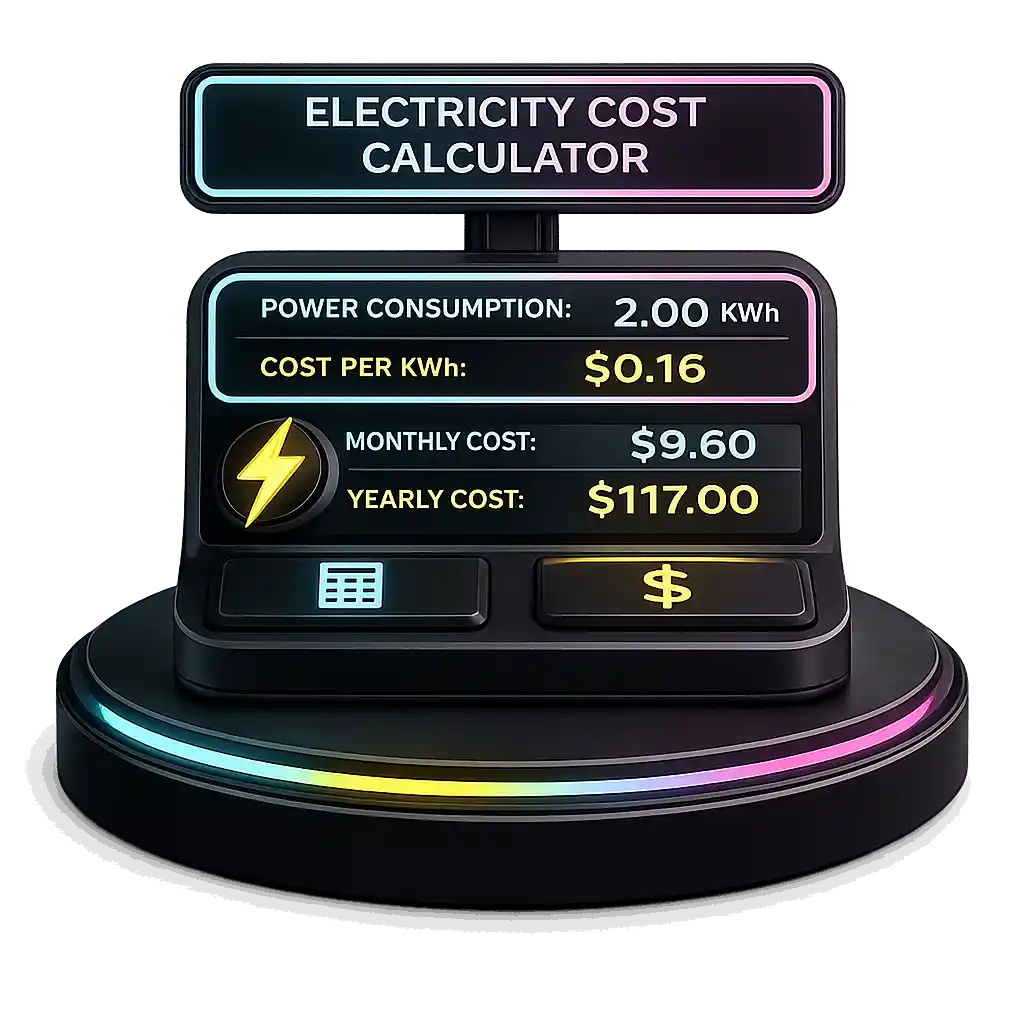
I use an electricity cost calculator when I want to know where my money is going, especially when comparing energy usage alongside other tools available on my performance and hardware calculator platform. It helps me estimate my annual electricity cost and even the cost of one appliance. I just enter my power consumption in kWh and my cost per kWh. That’s it. It quickly shows my monthly electricity bill and yearly total. According to the U.S. Energy Information Administration, the average electricity rate in 2023 was about $0.16 per kWh, so small changes really matter.
For example, I switched to LED bulbs and saw real LED savings compared to old bulbs. And when I bake a cake, my 1,000 watt oven running 2 hours uses 2 kWh. At $0.16 per kWh, that’s about $0.32 per day or around $117 per year. I also use it to compare appliance energy cost before and after changes. If I need more detail, I check a single appliance cost calculator too. And when comparing display upgrades that may increase power draw, I also use a Pixel Density Calculator to evaluate resolution changes before upgrading.
How the Electricity Cost Calculator Calculates Your Energy Usage
I look at it like this. The electricity cost calculator follows a simple power consumption formula. You enter three things: device power in watts or kW, how long you use it, and your cost per kWh, similar to how a PSU wattage calculator estimates total system power requirements before building a PC. Then it runs the energy usage calculation for you. The basic math is Energy in kWh equals Watts divided by 1000 times Hours used.
One kilowatt-hour means using 1,000 watts for one hour — similar to how pixel density calculators measure total pixels per inch when using a pixel density calculator. That’s the standard billing unit utility companies use. So if I run a 60 watt bulb for 5 hours, that’s 0.3 kWh. At $0.16 electricity rate, that’s about $0.048 per day. The tool also handles watts to kilowatts conversion and shows daily, monthly, and annual electricity cost formula results. If I’m unsure about bulb power, I sometimes check a lumens to watts calculator first.
How Much Does Electricity Really Cost? Example Breakdown
I’ll show you with a simple power usage calculation.
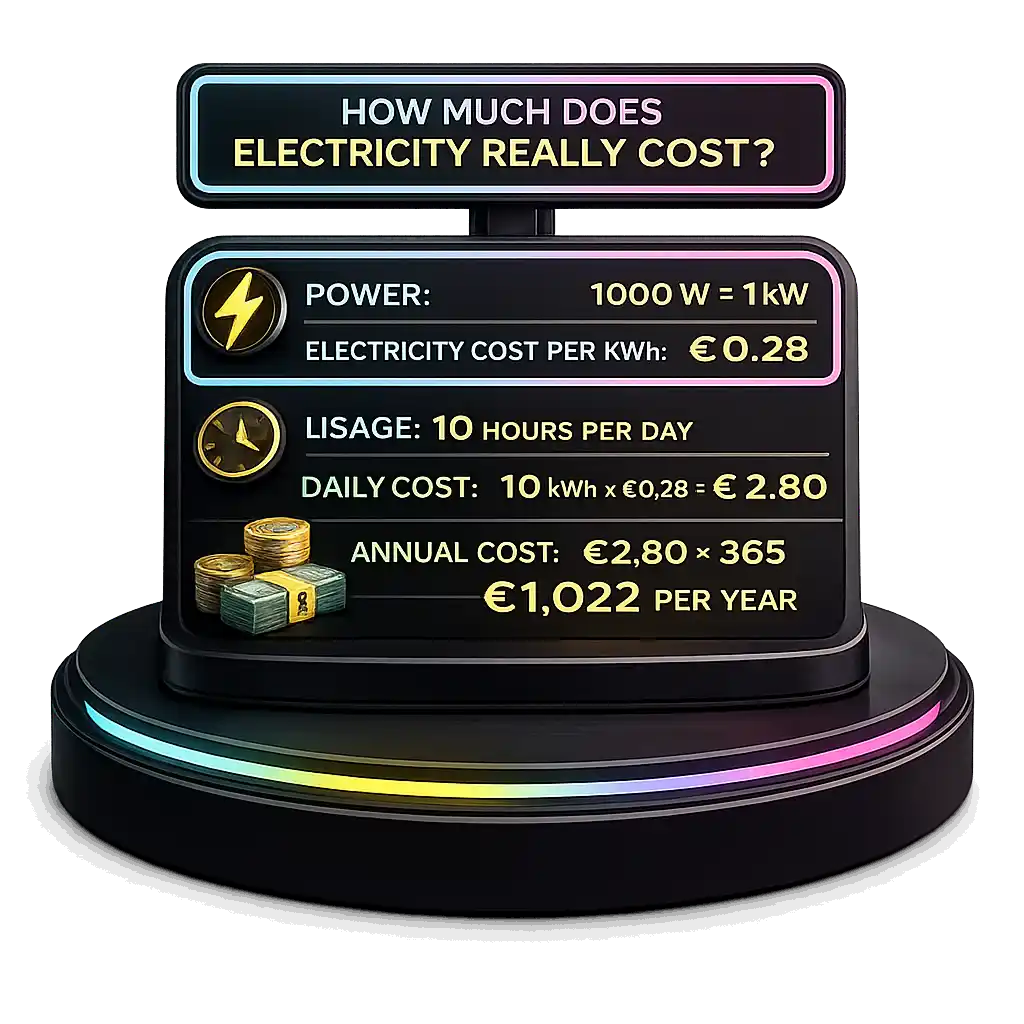
Power: 1000 W which is 1 kW
Electricity cost per kWh: €0.28
Usage: 10 hours per day
First, I convert watts to kilowatts. 1000 W equals 1 kW.
Now daily energy consumption. Energy equals Power × Time. So 1 kW × 10 hours equals 10 kWh per day.
Next comes the energy cost formula. Cost equals kWh × rate. So 10 × €0.28 equals €2.80 per day.
For the annual electricity bill, I multiply €2.80 × 365. That equals €1,022 per year. Surprised? That adds up fast.
€0.28 per kWh is close to common EU household rates. In Germany, rates often range between €0.30 and €0.40 per kWh.
Now here’s the interesting part. If I cut usage from 10 hours to 8 hours daily, that’s 8 kWh per day. That lowers the yearly cost to about €818. That’s around €204 saved.
And yes, an electricity bill estimator gives the same result instantly. I sometimes use a savings calculator to compare changes before I adjust my usage.
How to Calculate EV Charging Costs at Home
I get this question a lot. EV charging cost at home mostly depends on battery capacity kWh and your electricity rate. That’s it. But we also need to account for charging efficiency, because some power turns into heat during charging.
Here’s how I calculate it step by step.
- Find your battery size. Let’s say the electric vehicle has a 60 kWh battery.
- Check your cost per kWh. In 2023, the U.S. average electricity rate was about $0.16 per kWh, according to the U.S. Energy Information Administration.
- Multiply battery capacity by electricity rate. So 60 × 0.16 equals $9.60.
- Adjust for charging efficiency. Most home systems run at about 85 to 90 percent efficiency. Using 90 percent, divide $9.60 by 0.90. That equals about $10.67 for a full charge.
That’s your electric vehicle charging price for 250 miles if that’s the vehicle range. So EV cost per mile is around $0.04.
Compare that to gasoline at $3.50 per gallon and 30 MPG, just like comparing hardware efficiency using an FPS calculator before upgrading your gaming setup. That’s about $0.12 per mile. EV looks 60 to 70 percent cheaper per mile.
Level 1 or Level 2 charger cost changes charging speed, not the cost per kWh. I usually check a home charging cost calculator to confirm my numbers before planning trips.
What Is the Official Formula for Calculating Electricity Cost Per Charge?
The electricity cost formula is clearly defined by federal guidance. According to the U.S. Department of Energy, electricity cost equals the total energy used multiplied by the utility rate.
Cost = kWh × price per kWh, similar to how our timecode to frame converter calculates total frame counts based on time and frame rate inputs.
In this energy cost equation, kWh represents the total energy consumed. Utilities measure electricity strictly in kilowatt-hours, not watts — just like storage calculations focus on usable capacity when using a RAID calculator. One kWh equals using 1,000 watts for one hour. The price per kWh is the rate your utility company charges for each unit of energy.
For example, if an EV charge uses 40 kWh and the kWh pricing is $0.16, the cost per kWh calculation becomes 40 × 0.16. That equals $6.40 per charge.
According to the U.S. Department of Energy, Energy Saver Guide, electricity cost is calculated by multiplying the total kilowatt-hours consumed by the price per kilowatt-hour charged by your utility provider.
This EV charging formula does not include taxes or fixed service fees on your bill.
How to Calculate kWh Used from Battery Percentage
Sometimes I don’t charge my EV from empty to full. I might go from 20% to 80%. So I need to know the kWh from battery percentage to understand my real energy used per charge.
The EV energy consumption formula is simple:
kWh Used = Battery Capacity × (Percentage ÷ 100)
Let’s say the battery capacity is 75 kWh. If I charge from 20% to 80%, that means I used 60% of the battery. So the percentage to kWh conversion looks like this:
75 × 0.60 = 45 kWh
That means 45 kWh goes into the battery. But charging efficiency loss matters. Most systems run at about 85 to 90% efficiency. If I use 90%, then 45 ÷ 0.90 equals about 50 kWh drawn from the outlet.
So battery energy and wall energy are not the same, small efficiency differences add up over time, just like tighter memory timings can impact performance when tested with a RAM latency calculator.
If my car averages 3 to 4 miles per kWh, then 45 kWh gives me roughly 135 to 180 miles. Many EV makers suggest daily charging between 20% and 80% to protect battery life, so this EV battery capacity calculation becomes very practical.
kW vs. kWh in EV Charging: Understanding Power vs. Energy
According to the U.S. Department of Energy, Alternative Fuels Data Center, kilowatts measure power, while kilowatt-hours measure total energy used over time. Source: U.S. Department of Energy, Alternative Fuels Data Center.
Here’s the kW vs kWh difference in simple terms. kW is the rate of energy transfer, like speed. kWh is energy consumption measurement, like distance traveled. Your electricity billing unit is always kWh, not kW.
In EV charging power vs energy terms, a Level 2 charger kW rating might be 7 kW. If it runs for 4 hours, the EV charging cost calculation is 7 × 4 = 28 kWh consumed. You pay for 28 kWh, not 7 kW.
Level 1 charging usually runs around 1.4 to 1.9 kW. Level 2 ranges from about 3.3 to 19.2 kW. Faster charging does not change the price per kWh — similar to how adjusting internal render resolution with a resolution scaling calculator affects performance but not your electricity rate. Utilities charge homes based on kilowatt-hour usage, while demand charges based on kW mostly apply to commercial customers — just like display performance is measured differently when testing screens with a refresh rate test.
How Much Does It Cost to Charge a 27 kWh Battery from 30% to 80%? Step by Step Example
I’ll break this EV charging cost example down clearly. The cost to charge from 30 to 80 percent depends on battery size, electricity cost per kWh, and charging efficiency.
First, calculate the energy needed.
Battery capacity is 27 kWh.
Charge increase is 80% minus 30%, which equals 50%.
So the partial battery charge calculation is 27 × 0.50 = 13.5 kWh.
Next, adjust for home EV charging price efficiency. Most systems run at about 85 to 90 percent efficiency. Using 90%, divide 13.5 by 0.90. That equals about 15 kWh drawn from the outlet.
Now multiply by electricity rate. Using the U.S. average rate of about $0.16 per kWh in 2023,
15 × 0.16 = $2.40.
So the 27 kWh battery cost from 30% to 80% is roughly $2.40.
If the vehicle averages 3 to 4 miles per kWh, 13.5 kWh gives about 40 to 55 miles. At $0.30 per kWh, the same charge would cost around $4.50. Location clearly changes the final cost.
How to Convert Watts to Kilowatts for Accurate Electricity Cost Calculations
I always convert watts before doing any electricity cost calculation. Utility bills use the kWh billing unit, not watts. So if I skip the watts to kilowatts conversion, my numbers will be wrong from the start.
Kilowatts (kW) = Watts ÷ 1,000
That’s the basic kW formula. One kilowatt equals 1,000 watts.
Here’s a simple example. If an appliance uses 1,500 watts, I convert W to kW by dividing 1,500 by 1,000. That equals 1.5 kW. If I run it for 3 hours, the power to energy conversion becomes 1.5 × 3 = 4.5 kWh.
Now I apply the cost per kWh formula. At $0.16 per kWh, 4.5 × 0.16 equals $0.72.
Same idea works for EV charging. A 7,000-watt charger equals 7 kW. Since utilities charge in kilowatt-hours, not watts, this step keeps the calculation accurate.
FAQs
What are the factors affecting electricity costs?
Electricity costs depend on a few clear things. First is your electricity rate per kWh. That changes by state and provider. Second is total energy usage. The more kWh you use, the higher the bill. Third is appliance efficiency. Old AC units and heaters use more power. And location matters too. Taxes, fuel prices, and grid fees all affect your final bill.
How do I estimate electricity costs?
I usually start with this formula:
Cost = kWh × price per kWh
Check your appliance wattage. Convert watts to kW. Multiply by hours used. Then multiply by your rate. That gives a close estimate of your electricity bill.
How do I reduce my electricity costs?
I focus on usage first. Lower usage equals lower bills.
You can:
Use LED bulbs instead of incandescent.
Run appliances during off-peak hours if your plan allows it.
Upgrade to energy-efficient AC or fridge models.
Seal windows to reduce heating and cooling loss.
Small changes reduce annual electricity cost over time.
What are some major power consuming appliances at home?
Air conditioners usually use the most power. Electric heaters are also high. Water heaters, dryers, and ovens consume large amounts of electricity. Refrigerators run all day, so they add steady energy usage.
How do you calculate electricity cost?
You multiply total energy used in kWh by the cost per kWh. Utilities bill customers using kilowatt-hours, not watts.
How much does 1 kWh cost in MN?
Minnesota residential electricity rates typically range around $0.14 to $0.17 per kWh, depending on the utility provider and plan.
How much does 1 kWh cost in Alabama?
Alabama residential rates usually range around $0.13 to $0.15 per kWh, depending on provider and usage tier.
How to figure out how much electricity costs?
Look at your utility bill. Find your total kWh used and your rate per kWh. Multiply them. That shows the base energy charge. Fixed fees and taxes may be added separately.
Why is my electric bill $2000?
A $2000 bill usually means very high usage. Common causes include running large HVAC systems nonstop, electric heating in winter, charging multiple EVs, or equipment malfunction. Billing errors are rare but possible, so checking your meter reading helps.
Why are electric bills so high in Alabama?
High summer temperatures increase AC use. Older homes with poor insulation also raise power consumption. Fuel costs and regional grid factors can influence electricity rates. Heavy cooling demand is often the main driver.