
Gigabit vs Gigabyte: Key Differences Explained
Last updated:
I see this mix-up all the time. Gigabit vs gigabyte sounds almost the same. But they are not the same thing. And if you are picking an internet plan, this small detail really matters.
A gigabit, written as Gb, measures internet speed. Internet companies show speed in gigabits per second, also called Gbps meaning the data transfer rate each second. 1 gigabit equals 1,000 megabits. This is what your broadband speed and download speed use.
A gigabyte, written as GB, measures file size measurement and storage. 1 gigabyte equals 1,000 megabytes. And here is the key fact. 1 byte equals 8 bits. That is the core difference between gigabit and gigabyte. We compare GB vs Gb when talking about internet speed vs storage.
So if you download a 1 GB file on a 1 Gbps connection, it takes about 8 seconds in theory. Because 8 bits make 1 byte. Real speeds can be slower due to network limits.
Understanding bits and bytes helps you choose the right plan without confusion. If you want clearer answers about your speed, check your numbers carefully before upgrading using our online bottleneck calculator.
Key Takeaways: Gigabit vs Gigabyte
- Gigabit (Gb) measures speed, while Gigabyte (GB) measures storage size.
- Lowercase “b” = bits (internet speed), Uppercase “B” = bytes (file size/storage).
- 1 byte = 8 bits, so 1 GB equals 8 Gb.
- 1 Gbps internet ≈ 125 MB per second in ideal conditions.
- ISPs advertise speeds in Mbps or Gbps because networking standards use bits per second.
- Understanding the difference helps you choose the right internet plan and storage device without confusion.
Gigabit vs Gigabyte: Core Concepts Explained
People mix up bit vs byte all the time. The names look close. But they measure different things in digital systems. And even one small letter can change the meaning.
A bit, short for binary digit, is the smallest unit of digital information. It holds a 0 or a 1 in the binary system. Internet speed units use bits per second like bps, Mbps, and Gbps. Lowercase b means bit. According to the National Institute of Standards and Technology SI prefix guide, giga represents 10⁹ or 1,000,000,000. So 1 gigabit equals 1 billion bits.
A byte equals 8 bits. That is a fixed rule. Uppercase B means byte. Bytes measure data storage and file size measurement like MB or GB. Cloud storage and hard drives show capacity in bytes. In storage marketing, 1 kilobyte equals 1,000 bytes and 1 megabyte equals 1,000 KB. That is why Mbps vs MB can confuse people.
Gigabit vs Gigabyte: Key Differences in Speed & Storage
People often understand the basics, but the real confusion starts when speed and storage get mixed together. That is where the gigabit vs gigabyte difference becomes important.
The word giga comes from the metric system. It means 1 billion. So 1 gigabit equals 1 billion bits. And 1 gigabyte equals 1 billion bytes. Other metric prefixes follow the same pattern. Kilo means thousand. Mega means million. Giga means billion. Tera means trillion.
Now here is the part many people miss. 1 byte equals 8 bits. Because of that, conversions follow a clear rule.
1 kilobit equals 125 bytes.
1 megabit equals 125 kilobytes.
1 gigabit equals 125 megabytes.
1 terabit equals 125 gigabytes.
That is why 1 gigabit in megabytes equals 125 MB.
Internet connection speed uses gigabits per second. Gbps meaning gigabit per second describes the data transfer rate. If you have 1 Gbps broadband speed, it means 1 gigabit moves each second in theory. So downloading a 1 GB file takes about 8 seconds. But real speeds can be lower because of network overhead, latency, and traffic stability.
Megabit vs gigabit also shows scale difference. A gigabit equals 1,000 megabits. That is a big jump in internet speed.
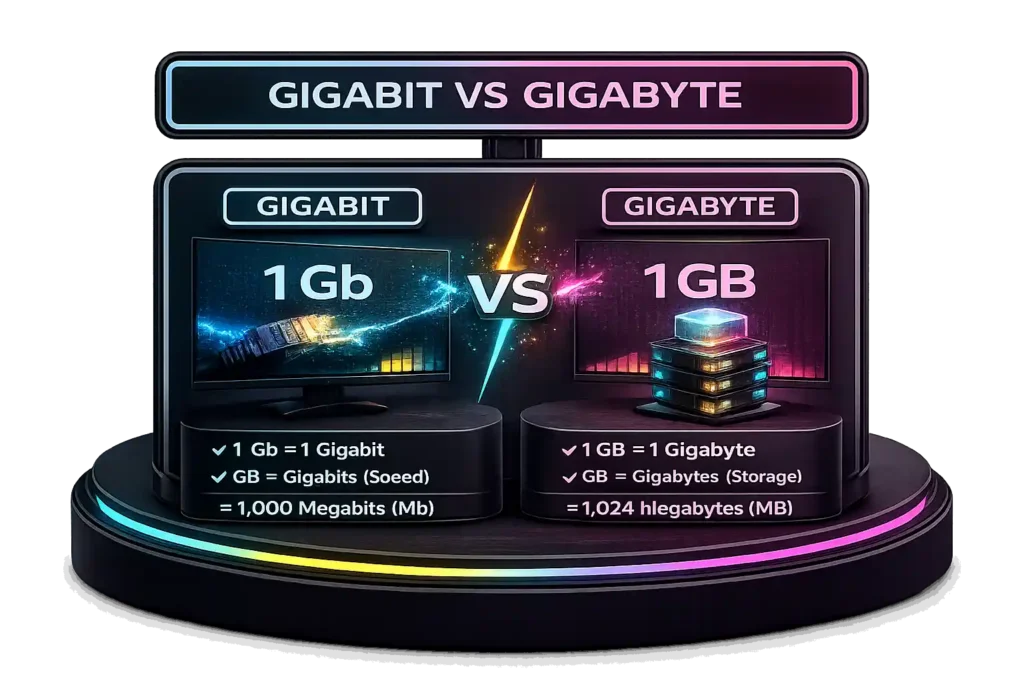
Gigabytes measure digital storage capacity. Hard drives, SSD storage capacity, USB drives, and cloud storage all use gigabytes, especially when you build a custom PC and choose your own components. Files are usually shown as file size in MB or GB.
One more thing. Storage companies use decimal values, so 1 GB equals 1,000 MB. Operating systems often use binary, where 1 GiB equals 1,024 MiB. That is why a 1TB drive shows slightly less usable space.
So in simple terms, gigabits measure internet speed, and gigabytes measure storage. Mixing them up leads to wrong expectations.
Why Gigabits & Gigabytes Matter for Business Internet
I see many businesses mix up speed and storage when choosing a plan. But for companies, gigabits and gigabytes both affect daily work. And picking the wrong one slows everything down.
Gigabytes connect to data storage capacity. Businesses handle big files, backups, customer records, and media content. Global data creation passed 120 zettabytes in 2023 according to Statista estimates. That growth means companies need larger storage systems, cloud-based services, and reliable network access. Hard drives, SSDs, and cloud storage plans all measure space in gigabytes and terabytes, which becomes important when you upgrade your PC for better performance.
Gigabits connect to business internet speed. A 1 Gbps business internet line moves 1,000 megabits per second. That supports high-bandwidth applications like video conferencing and cloud apps. Zoom HD calls use about 3 to 4 Mbps per stream. So a 1 Gbps connection could theoretically handle over 250 HD streams at once. Real speeds vary, but fibre broadband upgrade options improve stability and performance.
Remote working internet requirements increased sharply after the 2020 pandemic. Teams now depend on fast uploads, downloads, and steady connections.
At home, basic browsing may need less speed. But businesses depend on gigabit broadband for business productivity every day.
What Is a Gigabit (Gb) in Networking?
A gigabit, written as Gb with a lowercase b, is a unit used to measure internet speed. When people ask what is a gigabit, they usually mean broadband transmission rate. Gbps meaning gigabits per second tells you how fast data moves.
1 gigabit equals 1 billion bits per second. Networking uses decimal SI units, so 1 Gbps equals 1,000 Mbps. Internet providers show speeds in bits per second standard units.
100 Mbps
500 Mbps
1 Gbps
Higher numbers mean faster downloads, smoother streaming, and better multi device use, especially in high-performance systems that compare air vs liquid cooling setups.
Ethernet, fibre, and broadband speeds follow IEEE networking standards. The Institute of Electrical and Electronics Engineers sets rules like IEEE 802.3, which defines the Ethernet speed standard used worldwide.
What Is a Gigabit vs Gigabyte?
Gigabit
A gigabit, written as Gb with a lowercase b, measures internet speed. It shows how fast data moves. 1 gigabit equals 1 billion bits per second. This is part of internet speed measurement. And 1 Gbps equals 1,000 Mbps in the decimal networking standard.
100 Mbps
500 Mbps
1 Gbps
Higher numbers mean faster browsing, smoother streaming, and quicker downloads. Networking systems like Ethernet follow bits per second rules set by IEEE, including the IEEE 802.3 standard used worldwide, which matters when evaluating advanced builds like the pros and cons of vertical GPU installation in performance-focused PCs.
Gigabyte
A gigabyte, written as GB with a capital B, measures data storage size. 1 gigabyte equals 1 billion bytes. It tells you file size in GB or how much space a device holds.
HD movie about 3 to 5 GB
Video game 50 GB or more
Smartphone storage 128 GB or higher
The IEC defines binary prefixes too. A gigabyte equals 10⁹ bytes, while a gibibyte equals 2³⁰ bytes, which explains why storage numbers sometimes look different.
So the Gb vs GB difference is simple. Gigabit means speed. Gigabyte means storage.
Gigabit vs Gigabyte: What’s the Real Difference?
People mix this up a lot. The gigabit vs gigabyte difference is simple once you see it clearly. A gigabit measures speed. A gigabyte measures size. One is about how fast data moves. The other is about how much data you have.
Gigabit is written as Gb with a lowercase b. It measures broadband speed measurement. 1 gigabit equals 1,000 megabits. Internet plans show speeds in Gbps. Gigabyte is written as GB with a capital B. It measures file size in GB and storage. 1 gigabyte equals 1,000 megabytes. And 1 byte equals 8 bits. That is the key rule in bits vs bytes.
So internet speed vs storage is the real difference. Your provider sells Gbps speed. Your phone or SSD shows storage in GB. If you’re optimizing performance after upgrades, you can also track CPU thermals using MSI Afterburner temperature monitoring.
What’s the Difference Between Gigabit and Gigabyte in Internet Terms?
I see this confusion all the time. The difference between gigabit and gigabyte internet comes down to speed versus size. They sound similar, but they measure different things.
A gigabit, written as Gb with a lowercase b, measures internet speed. This is part of broadband speed measurement. Internet plans show speeds in Mbps or Gbps. Gbps meaning gigabits per second tells you how fast data moves. 1 Gbps equals 1,000 Mbps. Network speeds follow bits per second standards set by IEEE, including Ethernet rules under IEEE 802.3.
A gigabyte, written as GB with a capital B, measures data size or storage. Files show file size in GB or MB. Storage companies use decimal units, so 1 GB equals 1,000 MB. And 1 byte equals 8 bits.
Gb means speed
GB means storage
Lowercase b means bits
Uppercase B means bytes
For example, downloading a 1 GB file on a 1 Gbps connection takes about 8 seconds in theory. Real speeds vary due to network overhead.
Gigabit vs Gigabyte: Why ISPs Advertise Speeds in Gbps Instead of GB/s
Many people wonder why ISPs advertise in Gbps instead of GB per second. The confusion comes from gigabit vs gigabyte internet speed. The key reason is simple. Bandwidth is defined in bits, not bytes.
Networking systems measure transmission using the bits per second standard. Ethernet and broadband speed measurement rules follow IEEE 802.3 specifications, which define speeds in bits per second. So providers list speeds like 100 Mbps or 1 Gbps. And 1 Gbps equals 1,000 Mbps.
The FCC broadband speed guide also explains that internet speeds are measured in bits per second. The Federal Communications Commission uses this format in its consumer broadband guidelines.
Now here is the technical part. 1 byte equals 8 bits. So 1 Gbps equals 125 MB per second in theory. GB per second would describe file transfer or storage, not bandwidth vs data size.
So Gbps vs GB per second difference is about speed versus file size. ISPs advertise speed in bits because that is the official transmission standard.
How Many Megabytes per Second Is 1 Gigabit Internet Speed?
1 Gbps equals about 125 MB per second. That is the theoretical maximum speed.
Here is why. 1 byte equals 8 bits. Internet speeds use bits. File sizes use bytes. Networking follows the decimal standard, so 1 Gbps equals 1,000 Mbps.
Now the simple math for this internet speed calculation:
1,000 megabits ÷ 8 = 125 megabytes per second
That is the bandwidth conversion formula for Gbps to MB per second.
In real life, speeds are usually lower. Protocol overhead, TCP and IP processing, latency, and congestion reduce usable throughput by about 3 to 10 percent.
At 125 MB per second, a 5 GB file could download in around 40 seconds under ideal conditions.
Cloudflare’s networking glossary also explains bits vs bytes and bandwidth measurement this way, confirming the 1 Gbps in MB per second conversion.
How Long Does It Take to Download a 90GB Game on a 1 Gbps Connection?
A 90 GB game on a 1 Gbps connection takes about 12 minutes in perfect conditions.
Here is the simple math behind the 1 Gbps download speed time.
1 byte equals 8 bits, so 1 Gbps converts to about 125 MB per second.
ISPs use decimal units, so 90 GB equals 90,000 MB.
90,000 ÷ 125 = 720 seconds
720 seconds = 12 minutes
That is the theoretical 90GB game download time.
In real life, speeds are usually 10 to 20 percent slower. Network congestion, WiFi limits, or game server throttling from Steam or consoles can slow things down. So expect around 12 to 15 minutes.
For comparison, at 100 Mbps, the same download would take close to 2 hours.
Why Internet Speed Is Measured in Gigabits Instead of Gigabytes
Many people think internet speed and storage mean the same thing. But internet speed measured in gigabits refers to bandwidth, not file size.
Bandwidth means the network link capacity. It shows how much data can move each second. The bits per second definition explains this clearly. A gigabit, written as Gb, measures transmission rate. 1 Gbps means 1 billion bits move every second. Global Ethernet and fibre systems define throughput in bits per second under IEEE 802.3 standards.
Cisco networking documentation explains bandwidth as the maximum bit rate capacity of a link, not storage size. That means it measures data flow, not how much space a file takes.
A gigabyte, written as GB, measures storage. And 1 byte equals 8 bits. So 1 Gbps equals about 125 MB per second before overhead.
So bandwidth vs storage is the key gigabit vs gigabyte difference.
How to Convert Gigabits to Gigabytes (Gb to GB Conversion Formula)
Formula:
Gigabytes (GB) = Gigabits (Gb) ÷ 8
That is the full Gb to GB formula.
Here is why it works. 1 byte equals 8 bits. So to convert gigabits to gigabytes, you divide by 8. This is the basic bits to bytes conversion rule. Remember, Gb usually refers to speed, and GB refers to storage.
Now let’s do a simple gigabit to gigabyte calculation.
1 Gb ÷ 8 = 0.125 GB
8 Gb ÷ 8 = 1 GB
100 Gb ÷ 8 = 12.5 GB
Networking uses the decimal system. So 1 Gb equals 1,000 megabits. This bandwidth conversion formula is useful when converting Gbps to GB during downloads.
For example, if you download at 1 Gbps for 8 seconds, you transfer about 1 GB of data in theory. That is because 1 Gbps equals 1,000 megabits per second, which equals about 125 MB per second.
One more note. Storage companies use decimal units, where 1 GB equals 1,000 MB. Operating systems sometimes show GiB, where 1 GiB equals 1,024 MiB. That small difference explains why storage space can look slightly lower.
Why ISPs Advertise Speeds in Mbps Instead of MB/s
Many people ask why ISPs use Mbps instead of MB per second. The reason is simple. Broadband speed measurement follows the network bandwidth definition, which uses bits.
Internet speed describes data transfer rate in bits per second. Networking systems measure transmission in bits, not bytes. That is why providers show speeds in Mbps or Gbps. One important rule explains this clearly. 1 byte equals 8 bits.
If ISPs used MB per second, that would describe file transfer size, not link capacity. Mbps measures how fast data moves across the network, not how large the file is.
Here is a quick example.
100 Mbps ÷ 8 = 12.5 MB per second.
A 200 Mbps plan delivers about 25 MB per second in ideal conditions.
Ethernet standards under IEEE 802.3 define throughput in bits per second. The Federal Communications Commission broadband guidance also describes speeds in bits.
So Mbps vs MB per second difference comes down to bits versus bytes internet speed measurement.
Bit vs Byte Comparison
| Term | Symbol | Equals | Used For |
|---|---|---|---|
| Gigabit | Gb | 1 billion bits | Internet speed |
| Gigabyte | GB | 8 billion bits | Storage |
Here is the simple way I look at it. A gigabit, written as Gb with a lowercase b, measures broadband speed measurement. It equals 1 billion bits.
A gigabyte, written as GB with a capital B, measures storage. And since 1 byte equals 8 bits, 1 gigabyte equals 8 billion bits.
So Gb vs GB is really bits vs bytes. Speed versus storage.
Final Thoughts on Gigabit vs Gigabyte
I see this confusion all the time, but it really comes down to one simple rule. Gigabit means speed. Gigabyte means size. Lowercase b is bits for internet speed. Uppercase B is bytes for storage. And 1 byte equals 8 bits. That one fact clears up most of the mix-up.
So when you look at broadband speed, focus on Gbps. When you check file size or SSD space, look at GB. Once you understand the difference between gigabit and gigabyte, choosing the right internet plan or storage device becomes much easier.
FAQ’s
Is gigabyte the same as gigabit?
No. A gigabyte and a gigabit are not the same. A gigabit measures internet speed. A gigabyte measures storage size. The big difference is bits vs bytes. And 1 byte equals 8 bits. So a gigabyte is eight times larger than a gigabit in raw data terms.
Is 1GB the same as 1Gbps?
No, they measure different things. 1GB means 1 gigabyte of data size. 1Gbps means 1 gigabit per second of internet speed. Because 1 byte equals 8 bits, 1 Gbps equals about 125 MB per second in theory.
Is a gigabyte bigger than a gigabit?
Yes. A gigabyte is bigger. 1 gigabyte equals 8 gigabits. That comes from the core rule that 1 byte equals 8 bits.
Is 10 gigabit equal to 1 gigabyte?
No. 10 gigabits equals 1.25 gigabytes. You divide by 8 to convert gigabits to gigabytes.
Is 1 gigabit internet overkill?
For basic browsing, maybe yes. But for heavy streaming, gaming, remote work, and many users at once, 1 gigabit internet handles it easily. It supports high bandwidth use without slowdowns.
Is 10G faster than 5G?
Yes. In networking terms, 10G means 10 gigabits per second. That is double 5 gigabits per second. But 5G mobile networks and 10G wired broadband are different technologies, so real world speeds can vary.