
The Strength That Rises From the Broken Places
The world breaks everyone, and afterward, many are strong at the broken places. Even the darkest night will end and the sun will rise. He had a massive heart, a heart big enough to hold all the sorrow of the world.
1. The World Breaks Us Without Warning
Pain arrives unannounced, like a storm that chooses its own hour. Every person is broken in ways unseen at first glance, by loss, by love that vanished, by promises that dissolved, or by grief that settled too deep. The fractures begin early, before we learn the language of recovery. We often spend years carrying pieces of ourselves we never realized were missing. The world breaks us not with cruelty alone, but with inevitability. The human heart is built to be tested, bent, stretched, and sometimes cracked open so new shape can form. What feels like destruction is often preparation. The breaking is universal, but the rebuilding is where individuality begins.
2. Strength Is Rebuilt in Small Fragments
Healing does not rebuild us in one dramatic moment. It grows back in fragments we collect along the way. One day we reclaim a little courage. Another day we recover a small belief in ourselves. On quieter days, we repair trust, not in others yet, but in our own ability to endure disappointment without disappearing. Strength is not a trophy; it is a gradual accumulation. It comes from repetition, waking up again, trying again, loving again more wisely, and choosing again even when the heart still remembers impact. Broken places become reinforced, not erased. The strongest parts of a person are often the areas that once needed the most repair.
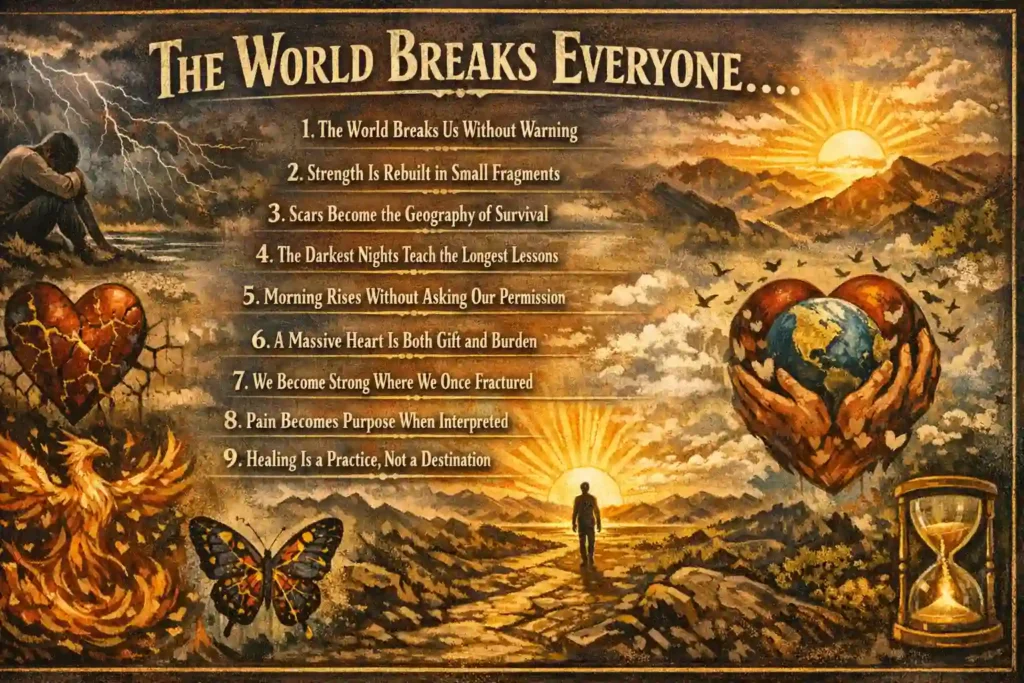
3. Scars Become the Geography of Survival
Scars are not signs of ruin. They are evidence of having lived through what was meant to weaken us. They map the terrain of our endurance. A scar means something tried to end us and failed. Emotional scars work the same. The places that once bled eventually become the areas we guard with clarity. What once felt like vulnerability becomes awareness. What once felt like humiliation becomes humility mixed with confidence. Scars do not fade to make us forget; they remain to make us remember we are capable of withstanding what once felt unsurvivable. They are not beautiful because they are painless, but because they are victorious.
4. The Darkest Nights Teach the Longest Lessons
Dark nights are not measured by clocks, but by transformation. Some nights stretch into months, some into years, some into emotional seasons where light feels more like memory than reality. Yet, darkness carries its own curriculum. It teaches us who stays when the world grows heavy. It teaches us what we should no longer tolerate. It teaches us which parts of ourselves were built for applause and which were built for endurance. The longest lessons often come without witnesses. The world may not see the breaking, but it eventually recognizes the strength that returned from it. The darkest nights are not obstacles to the sun, they are contrast that makes the sunrise credible.
5. Morning Rises Without Asking Our Permission
The sun does not negotiate with despair. Morning arrives even when we doubt it the night before. People often believe they must earn better days through perfect healing, flawless optimism, or extraordinary bravery. But morning is not transactional. It is faithful to time, not emotion. Even when the heart feels reluctant, even when belief is exhausted, even when grief is still seated near the window, morning rises. Light returns not as a judgment, but as continuity. The strongest people are not those who always believed in sunrise, but those who witnessed it return even on days when they no longer expected it to. Morning is not a promise, it is proof.
6. A Massive Heart Is Both Gift and Burden
A heart large enough to hold the sorrow of the world often carries a dual destiny. It loves deeply, grieves deeply, absorbs deeply, forgives too quickly, empathizes too widely, and sometimes collapses under the weight of its own capacity. Massive hearts are rarely selfish, but often unprotected. They believe love must be limitless to be real. They believe saving others is the same as loving them. They mistake exhaustion for devotion. But eventually, a large heart learns refinement. It learns selective mercy. It learns emotional triage. It learns that loving the world does not mean carrying all of it at once. A massive heart becomes wise not when it shrinks, but when it learns distribution instead of total possession of sorrow.
7. We Become Strong Where We Once Fractured
The broken places do not remain empty. They become reinforced zones of identity. The world does not repair us symmetrically; it repairs us strategically. We become stronger not in places that were always easy, but in places that once demanded explanation, survival, adaptation, or reinvention. The heart that once shattered from abandonment eventually learns self-sufficiency. The person who once dissolved under rejection eventually learns internal validation. The voice that once shook under confrontation eventually learns articulation without apology. Strength is not linear, it is local. It is concentrated in the coordinates of past damage.
8. Pain Becomes Purpose When Interpreted, Not Avoided
Pain only becomes wisdom when it is interpreted, confronted, or translated into boundaries. Avoided pain becomes a loop; examined pain becomes leverage. When a person understands their wounds, they stop recruiting love that resembles harm. They stop accepting inconsistency as intimacy. They stop confusing chaos for passion. They stop mistaking emotional crumbs for destiny. Pain becomes purpose when it stops being a secret and starts being a teacher. The lesson is not to never break again, but to never misunderstand the break as final definition.
9. Healing Is a Practice, Not a Destination
Self-worth is not discovered, it is rehearsed. Healing is not a destination we reach; it is a set of decisions we repeat. The cycle breaks the moment we stop agreeing to old emotional contracts drafted in our early years. Love becomes healthier when we stop negotiating our dignity. Conflict becomes manageable when we stop fearing opposition more than self-loss. Morning becomes believable when we stop demanding ourselves to be perfect before witnessing light. Strength is not the reward for being unbroken; it is the outcome of refusing to let brokenness have the final identity. The world breaks everyone, but it does not get to define anyone who chooses to rebuild.